Beaches of
NormandyTours
NormandyTours
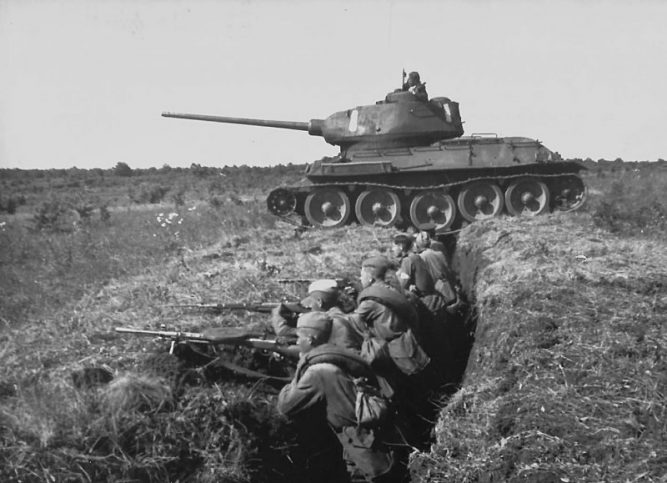
Our past articles about tanks (M3 Lee) (M4 Sherman) (Churchill) (Cromwell) (Panzer IV) (Tiger) (Tiger II) concentrated on the Western Front. This time, we turn east and look at the ubiquitous T-34, the medium tank that symbolized the ability of the Soviet war industry to pick itself up during the hardest days and create a well-rounded if somewhat rough tank to turn the German tide with. The most-produced tank of World War II and the second most-produced tank ever (losing out to another Soviet design, the T-54/T-55), the T-34 is one of the heroes of World War II.
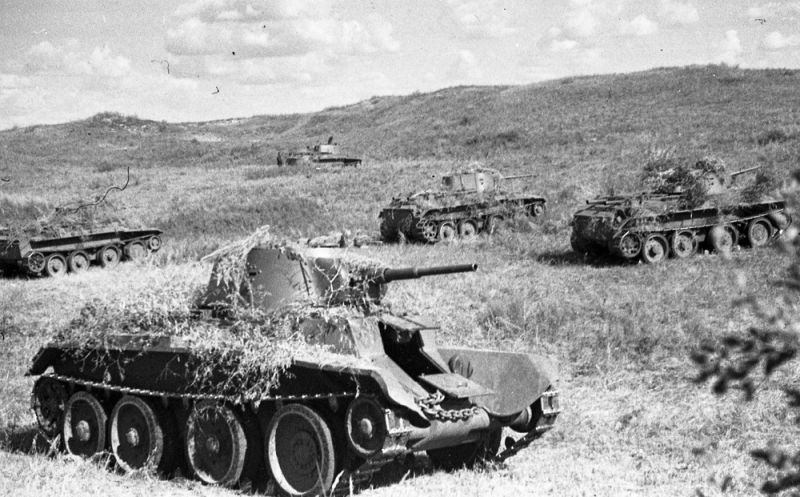
The two most numerous tank types in the Red Army shortly before World War II broke out were the T-26 and the BT series. The former was a ponderous infantry tank, only designed to keep pace with soldiers on foot. The latter were fast but thin-skinned. Experience in the Battles of Khalkhin Gol (where future Soviet Marshal Georgy Zhukov (Zhukov) made a name for himself) also showed that the gasoline engine of the BT tanks was a liability: Japanese troops could get close to the tanks and set their engines on fire with Molotov cocktails as the flaming oil could seep through the poorly-assembled armor plates. Additionally, both tank types were of foreign origin: the T-26 was based on the British Vickers 6-ton, and the BT tanks on the work of American engineer J. Walter Christie.
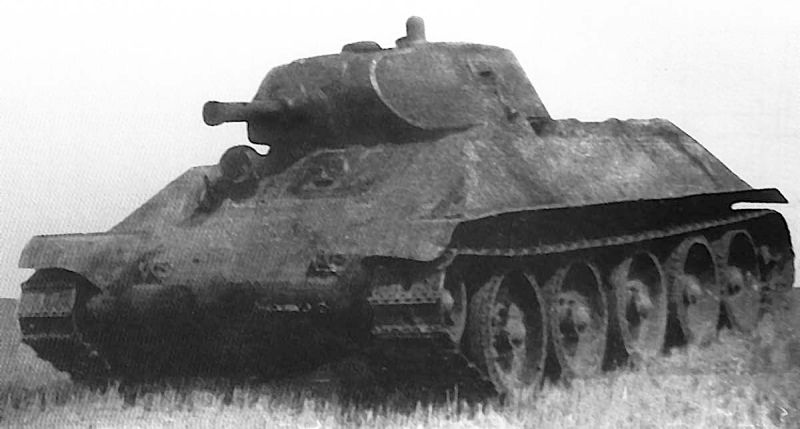
Soviet engineer Mikhail Koshkin was put in charge of designing a replacement for the BT series. The first prototype, designated A-20 for having 20 mm (0.8 in ) armor in the front, was armed with 45 mm gun, had an easier-to-manufacture hull, ran on less-flammable diesel fuel, and retained the BT’s ability to move much faster on roads by removing the tracks. (This latter functionality was later discarded, since the necessary equipment was complex, and offered little benefit in a defensive war waged inside the Soviet Union which had few developed roads.) It also had better range and could carry more ammunition.
After bad experiences with existing tank designs against the Japanese, Stalin gave Koshkin permission to create a new, improved prototype. This was the A-32, designated after the 32 mm (1.3 in) frontal armor. The main armament was replaced by a more powerful 76.2 mm caliber L-10 gun. The armor was still relatively weak, but the use of sloped armor increased its practical thickness, giving it decent deflective power against many tanks that were still firing low velocity shells. While heavier than the A-20, the A-32 retained its mobility and was faster than many other medium tanks at the time. A still heavier version, the T-32, equipped with a newer L-11 gun of the same caliber and more amor, was approved for mass production as the T-34. The “34” in the designation came from Koshkin, who claimed he started coming up with the fundamental design of the tank in 1934. The T-34 was a substantial improvement over both the BT and T-26 tanks, and was set to become the Soviet Union’s standard medium tank.
In April and May 1940, two completed T-34 prototypes undertook a grueling 1,200-mile (2,000 km) journey to prove the design’s practicality. They traveled from Kharkiv to Moscow, then to the Mannerheim Line in Finland, and back to Kharkiv via Minsk and Kiev. Koshkin himself went on the journey and drove one of the tanks. He caught pneumonia on the way and died of complications later in the year.
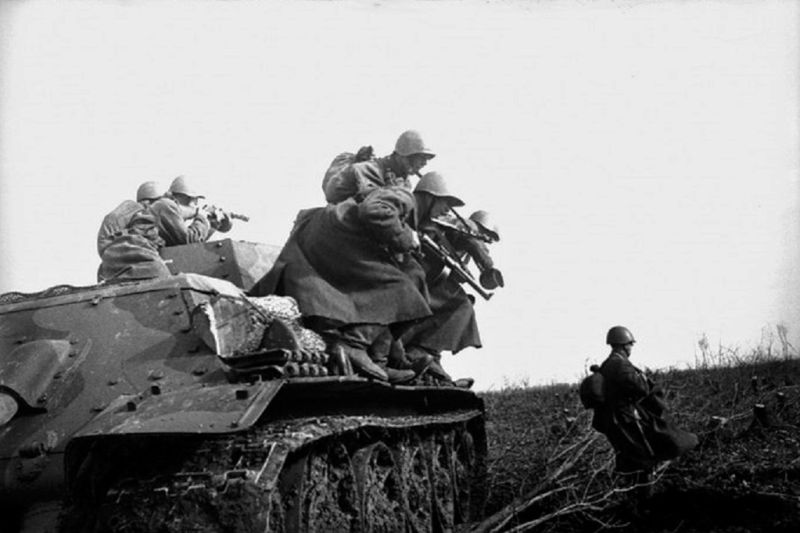
One interesting feature of the T-34 was a set of handrails on the outside. Tanks need infantry to protect them against ambushes with anti-tank weapons, but the Red Army did not have enough trucks or other vehicles for soldiers to get around on wheels. Instead, tank desant troops would ride on the outside of a tank and hop off to fight.
Soviet leadership was initially hesitant because of the T-34’s higher production cost. Their minds were quickly changed by the poor performance of older tanks against Finland in the Winter War of 1939-1940, and the alarming success of German tanks in France, and production was given the go-ahead. Early teething problems include poorly made armor plates, since Soviet industry had no experience with plates of this thickness. Armor was sometimes so shoddy that rain could seep into the tank, short-circuiting the electronics. Only the tanks of company commanders came with radios, forcing other tanks to communicate by flag signals. The gun was a bit of a letdown and was once again replaced by a new type, the F-34. This remained a viable weapon until the Germans started fielding Tigers and Panthers, and, in fact, gave the T-34 more firepower than the contemporary model of the KV-1 heavy tank. This version is commonly called the T-34/76 after the gun caliber to distinguish it from the later T-34/85.
A note on nomenclature is in order. All the designations with a slash (“T-34/76,” T-34/85”) were used by the Germans. The Soviets themselves described various versions of the 76 mm gun tank as “T-34 Model 1940,” “T-34 Model 1941,” etc. This changed with the introduction of the 85 mm gun version, which they called “T-34-85,” but with a hyphen rather than a slash. This article follows the German nomenclature for uniformity.
The German invasion of the Soviet Union caught the country unprepared, and only 967 T-34s were already in service at the time. Even most of those were destroyed, partially due to poor leadership, tactics and crew training, and partially due to teething problems such as frequent breakdowns of the clutch and the transmission gear. Even so, the T-34 (and the KV-1 heavy tank) shocked the Germans, who did not have any anti-tank weapons capable of reliably taking them on. The standard German anti-tank gun, the 27 mm PaK 36, was nicknamed Panzeranklopfgerät, “tank door knocker,” since all it could do to a T-34 was knock on it harmlessly.
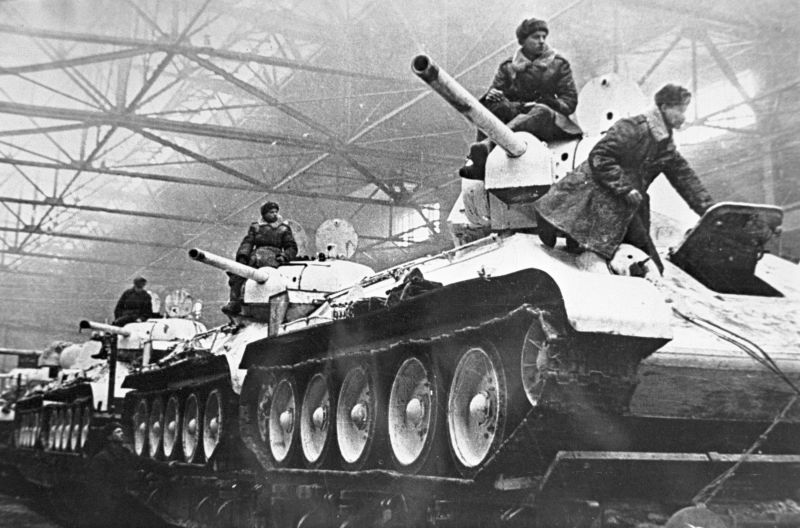
The trial by fire revealed certain weaknesses in the T-34’s design and manufacture. The armor was very hard and brittle, which meant that high explosive shells hitting it from the outside could create spalling, fragments breaking off on the inside and wounding crewmen. Shifting gears was inhuman work: the driver had to exert 101 to 247 pounds (46-112 kg) of force to shift from 2nd to 3rd; a later change reduced this to “only” under 68 pounds (31 kg). The small turret only accommodated two people for a total crew of four; the commander had to double as gunner (some sources claim loader), which greatly reduced his ability to pay attention to the tactical situation. Things were made worse by low-quality optics for targeting and poor tactical visibility. With the hatch down, the commander could only see through a single vision slit and a traversable periscope, but had no 360° cupola. The hatch opened forward, so it blocked the commander’s vision if he opened it to look out. The poor tactical vision forced three-tank platoons to concentrate on a single target rather than spread their fire around through independent aiming. Additionally, German tanks could get off an average of three shots for every one fired by a T-34. The T-34 also lacked a turret basket, a floor that rotated with the turret – this was a safety hazard, as crewmen could be injured by the moving mechanism. Additional problems included an early air filter which failed to let in enough air and choked the engine of oxygen, and a transmission so poor that crews usually carried a spare one for in-the-field replacement.
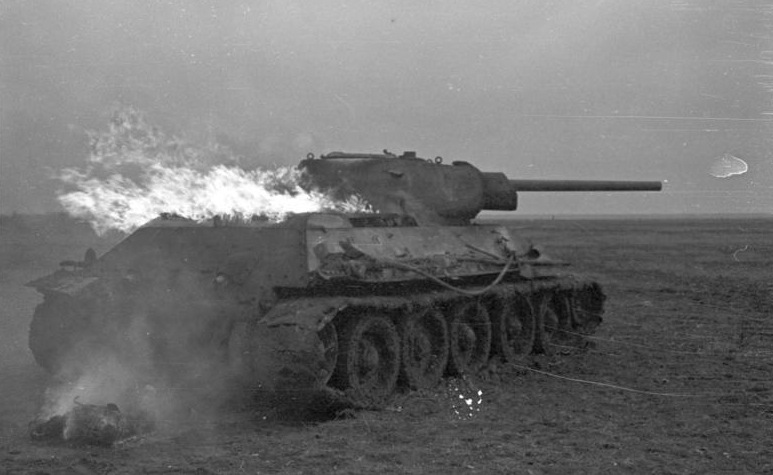
Fixing these problems early on during the German invasion was impossible, as Soviet industry was strained to its limits. Entire factories had to be evacuated, moved and rebuilt in the safety of the hinterlands east of the Ural Mountains. Workers sometimes manned the workshop machinery even before the roof was completed over the assembly floor. The Dzerzhinsky Tractor Factory in Stalingrad worked double shifts during the battle for the city, and there are stories of unpainted tanks rolling off the assembly line and directly into battle a few hundred yards away.
Changes were, for the time being, restricted to simplification of production. The 1941 model of the gun was reduced from 861 parts to 614. All-steel roadwheels were introduced due to a lack of rubber, and new methods of welding and hardening the armor plates were introduced.
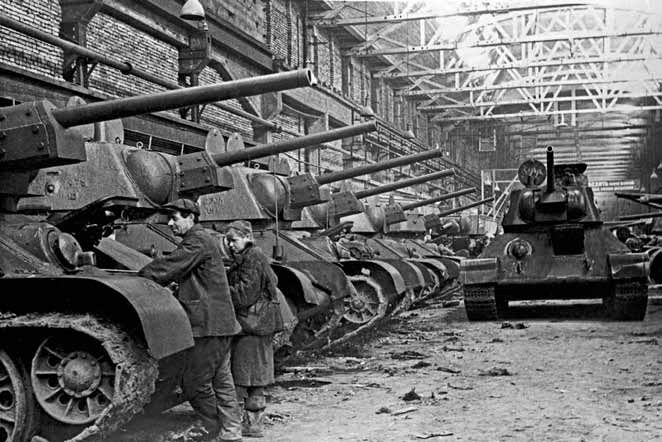
Once early problems were addressed, the T-34/76 became a formidable weapon. The Germans, however, were also improving their own equipment by introducing heavier-caliber anti-tanks guns, upgrades to the Panzer IV, and the introduction of the Tiger and Panther tanks. The Battle of Kursk (The Largest Tank Battle in History) and other battles in the summer of 1943 showed that the T-34 was no longer as effective as it was two years earlier. A new, major upgrade was needed.
Back in 1941, a T-34 was already experimentally equipped with the new 57 mm ZiS-4 anti-tank gun. It showed impressive promise, even though the prototype was very inaccurate and wore out rapidly due to improper rifling. A fixed version was accepted for production, but only 10 such tanks were made. These are described in Soviet documents as “T-34 with ZiS-4,” but the unofficial designation “T-34/57” and the post-war nickname “Exterminator” are also use in use. These Exterminators never entered real production for a number of reasons. There weren’t enough armor piercing shells of this caliber available, but more importantly, the introduction of a new model would have disrupted tank production at a time when any slowdown would have jeopardized the war effort.
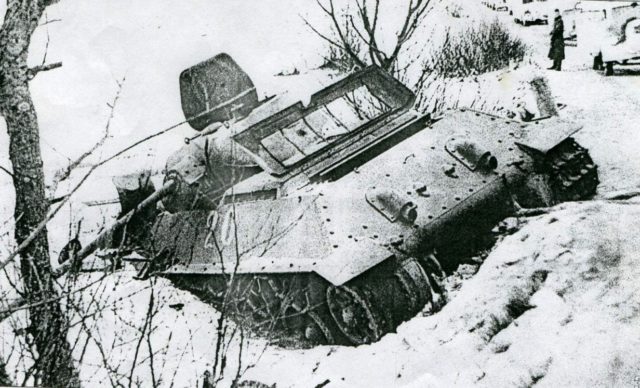
With the T-34/76 getting long in the tooth by 1943, the idea was dusted off and another tank was mounted with a ZiS-4M. This one never saw combat, though the first ten Exterminators did fight in the Battle of Moscow.
Another attempt to keep up with German developments was the T-43, which was supposed to replace both the T-34 and the KV-1. This was better armored and 70% of its parts were interchangeable with the T-34, but it was slower and still couldn’t withstand the German 88 mm gun, so the project was shelved in favor of upgrading the already existing T-34.
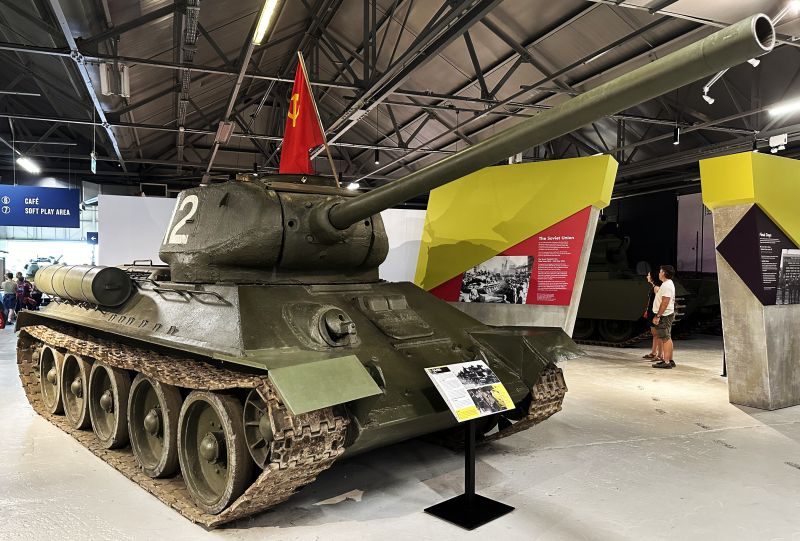
The real upgrade, the one that panned out, was the T-34/85. It had a larger turret that not only accommodated the new gun, but could also fit three crewmen, freeing up the commander to concentrate on tactics. The turret came with a radio (previously, the tanks that did have a radio had them in the hull), and an observation cupola for all-around vision. The turret’s frontal armor was increased to 90 mm. The hull retained its 45 mm of armor on all sides, with more effective thickness due to the sloped shape. (Such uniformity was unusual compared to many other tanks at the time, which had thicker armor on the front and also differentiated between upper and lower hull.)
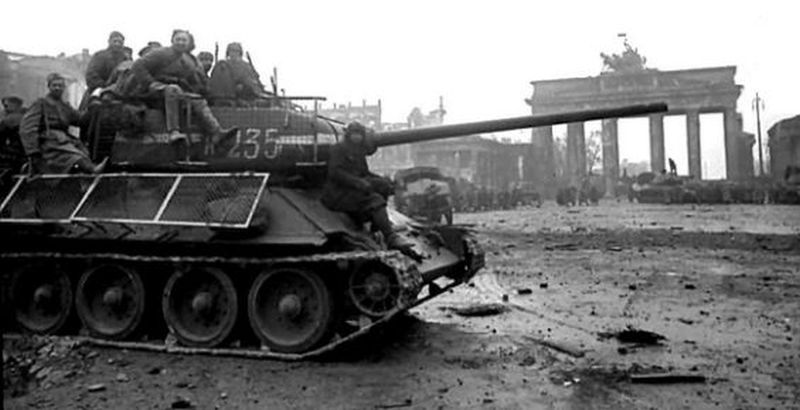
The most obvious change, of course, was the new gun, the 85 mm ZiS, which gave the “85” type designation. Like the dreaded 88 mm gun of the German Tiger I and II tanks, this one, too, was adapted from an anti-aircraft gun. One drawback of the new gun was a longer barrel which stuck out in front of the tank and could hit the ground in rough terrain. According to one tank commander, "the tank could have dug the ground with it in the smallest ditch [filling the barrel with dirt]. If you fired it after that, the barrel would open up at the end like the petals of a flower." It was standard practice to fully elevate the gun or turn it backwards when traveling outside of combat to avoid such accidents.
T-34/85s were initially given to Red Guards battalions, which were considered elite units. They quickly became popular with the crews, and the new version gradually replaced the T-34/76 in all units.
The introduction of the T-34/85 swung the balance back in favor of the Red Army. The new design had better armor and mobility than the Panzer IV and the StuG III assault gun. It was no match for a Tiger or Panther one-on-one, but they were good enough against them, and overwhelming numbers could more than compensate for individual inferiority. One particular battle in January 1945 saw the permanent loss of 7 Tiger Is, 5 Tiger IIs and 5 Panthers at the cost of only 4 T-34/85s. The T-34/85 continued production and service until the end of the war.
Approximating the ideal balance of mobility, firepower and protection, the T-34 was good enough that the Germans regularly repurposed captured specimens, repairing them and modifying them to German requirements before sending them back to the front.
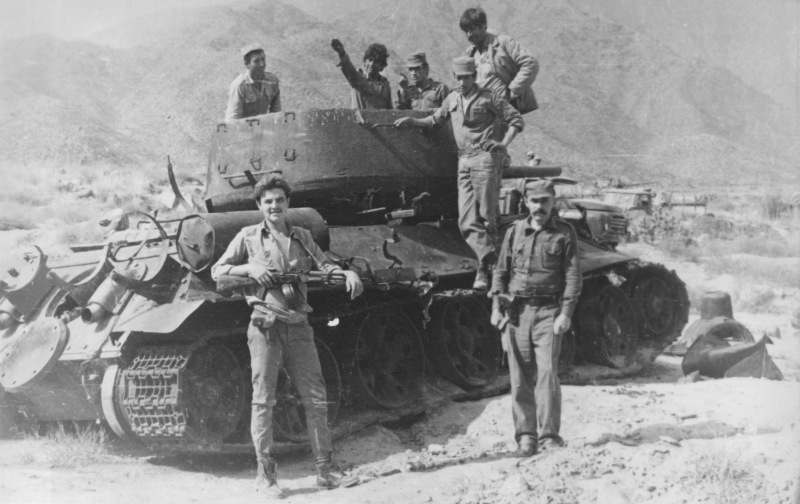
The T-34 became an icon of Soviet war industry, and went on to serve in numerous other wars. Soviet-supplied T-34/85s formed the spearhead of the North Korean invasion of South Korea in 1950, at the beginning of the Korean War. They withstood fire from Word War II-era American bazookas (The Bazooka) and M24 Chaffee light tanks, though they started taking heavy casualties from airstrikes, Super Bazookas, M4 Shermans and newer tanks. They also served in numerous other conflicts of the Cold War, including the Arab-Israeli Wars, the Soviet war against Afghan mujahideen, the Vietnam War, the Angolan Civil War and the wars following the break-up of Yugoslavia.
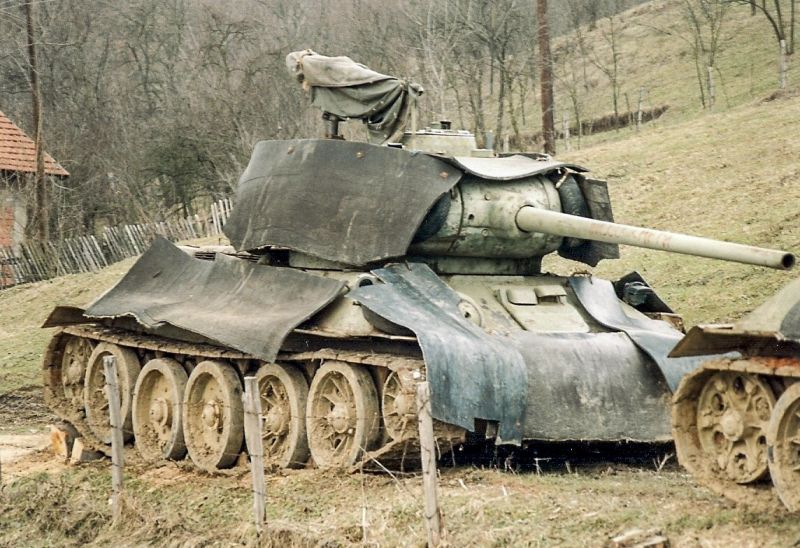
With over 84,000 T-34s produced, it’s no surprise that you can find them in many military museums and as war memorials all around the world. You can meet T-34s on our Band of Brothers Tours, Britain at War Tour, Third Reich Tour, War in Poland Tour, and Vietnam War Tour. You can also see some disguised as German Tiger tanks in several war films, including Saving Private Ryan and Kelly’s Heroes.



Beaches of Normandy Tours
Beaches of Normandy Tours SAS, Normandy, France
Band of Brothers Tours
Band of Brothers Tours FZCO, Dubai, UAE