Beaches of
NormandyTours
NormandyTours
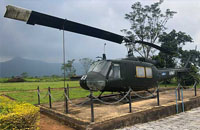
Few military vehicles are as iconic of the Vietnam War as the Huey helicopter, officially the Bell UH-1 Iroquois. It was a manifest representation of the asymmetric nature of the war: it was the bird that could take American soldiers to almost any spot in the rough Vietnamese landscape, it could evacuate the wounded, and it could provide supporting fire; but for all that, the troops would eventually board their flight back to base, and the villages and the jungle would be taken back by the Viet Cong and the North Vietnamese Army.
The need for military helicopters
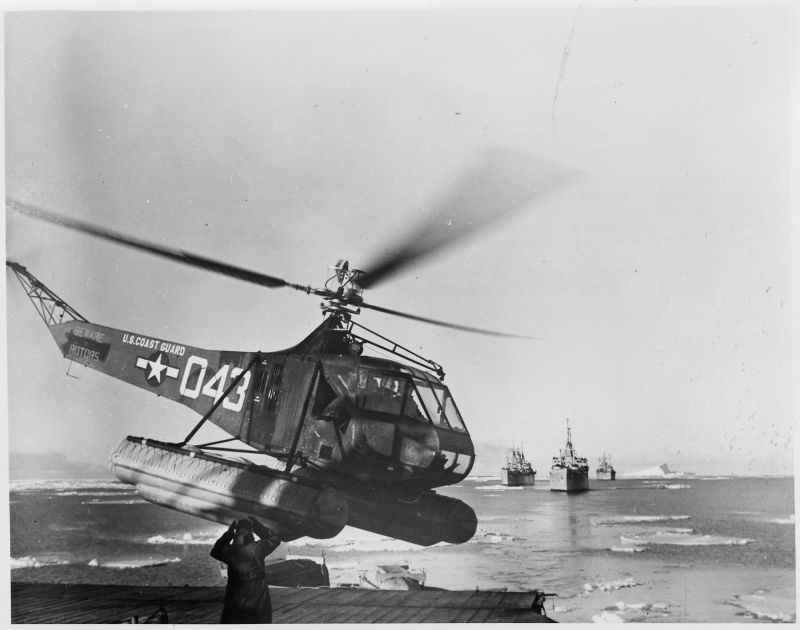
Helicopters were not a new idea by the time of the Vietnam War. The first practical, fully controllable helicopter was the Focke-Wulf Fw 61 built in Nazi Germany, and the first one to reach full-scale production was the American Sikorsky R-4 in 1942. It's no coincidence that the R-4 was adopted by the U.S. Armed Forces and used for medical evacuation (medevac). Helicopters seem uniquely well-suited for the task: they are fast and can get the casualties to a medical facility in time, they can land in places unsuited for airplanes, and while their carrying capacity is very limited, it's still enough for one or several wounded soldiers. The same qualities also make copter great utility vehicles that can get a small number of people or a limited amount of equipment to practically anywhere at short notice.
Inception of the Huey
Other helicopter types followed the R-4 in American service, and the Huey was a part of that lineage. In 1954, the U.S. Army put out a call for a new utility and medevac helicopter that was smaller, more powerful and easier to maintain the current designs. It was supposed to have a cargo capacity of 360 kg (790 lb), a range of at least 365 km (227), a cruising speed of 184 km/h (114 mph), and a service ceiling of 1,800 m (5,905 ft). These were pretty steep expectations at the time, but Bell Helicopter's Model 204 (204 and 205 being the civilian versions of the Huey) met and exceeded them.
.jpg)
The superior performance was linked to the fact that the 204 was one of the first helicopters to use a turboshaft engine instead of a traditional piston-based one. Turboshafts are very similar to turboprops in planes in that they compress and heat up (by burning fuel) the air flowing through them, increasing the energy of the gas, which then turns a turbine – only the turbine's rotation is transferred to the rotor wings instead of an airplane-style propeller. Turboshafts are more expensive than piston engines of comparable power (not a problem for the U.S. military) and less fuel-efficient, but can have the same power in a significantly smaller and lighter package, which is a big upside for small aircraft. Even so, the 860 shaft horsepower of the initial Lycoming YT53-L-1engine (derated to 770 to improve reliability and allow short bursts of extra power) quickly proved a bit anemic, and the engine was replaced by more powerful ones in later models. The two-bladed rotor, which is responsible for the Huey's distinctive sound, was a trade-off: it reduced the storage space required for the vehicle, but also caused higher vibration levels.
The new aircraft was officially named Bell HU-1 Iroquois, following the tradition of naming U.S. military helicopters after Native American nations. Hardly anyone actually called it that, however. "HU-1" stood for "Helicopter Utility 1," and quickly spawned the popular nickname "Huey." The code was changed to "UH-1" in 1962 to bring it in line with new designation conventions, but the nickname stuck forever.
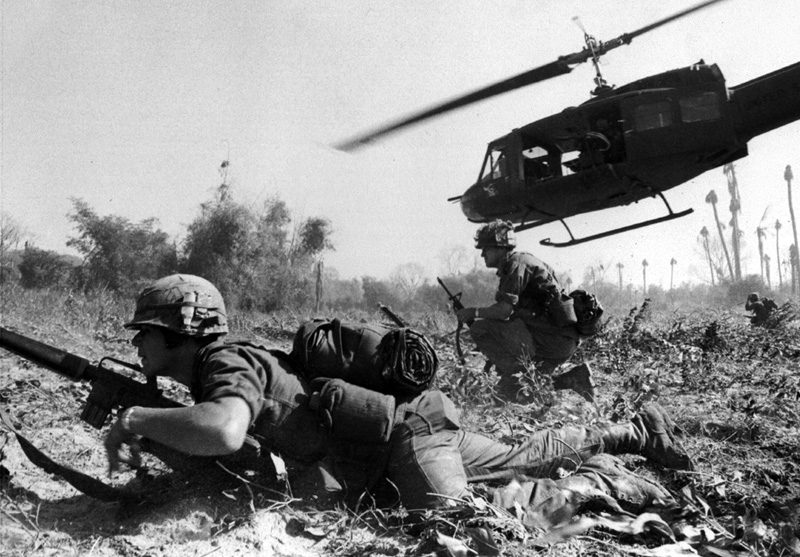
The Huey first entered service with the 101st (The Screaming Eagles) and 82nd (The All American Division) Airborne Divisions and the 57th Medical Detachment. The first few specimens were only intended for evaluation, but the units enthusiastically pressed them into operational service, and the 57th Medical Division started using its Hueys in genuine combat conditions when it arrived in South Vietnam in 1962.
Service in the Vietnam War
Constant feedback and a widening range of needs spawned numerous versions and modifications of the versatile helicopter. Besides medevac, search and rescue and cargo transport, the Huey eventually became a platform for air assaults (carrying infantry that would dismount directly into combat), ground attacks and electronic warfare.
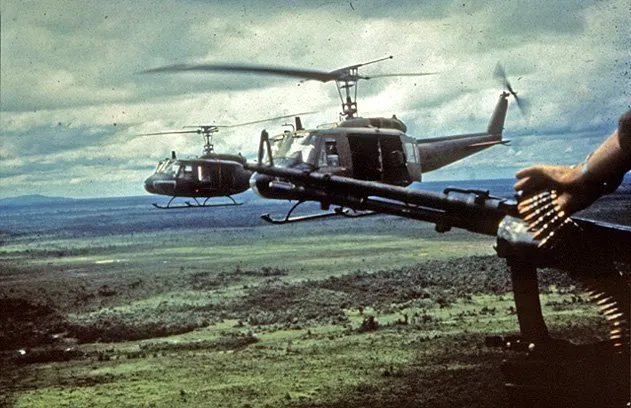
The regular Huey already came with two door machine guns to protect dismounting troops, but it became evident that mounting more weapons would allow it to support ground combat more effectively, and individual companies started jury-rigging their own mounting systems on Hueys very early on, with official experiments also appearing later on. These modified "gunship" Hueys were commonly called “Cobras" or "Guns" if they carried extra guns, and "Frogs" or "Hops" if they were armed with rockets; regular unmodified ones were nicknamed "Slicks" because they didn't have extra weapon pods. The idea was not new, since the French already used helicopters with makeshift armament in Algeria in the 1950s. Armed Hueys eventually started acting as hunter-killer teams apart from ground operations, cooperating with Bell OH-58A Kiowa and Hughes OH-6 Cayuse (a.k.a. Loach) observation helicopters. Some Hueys also carried wire-guided TOW anti-tank missiles late in the war.
Besides a variety of rockets, missiles and 7.62 mm machine guns (such as the M-60), the Army also tried to fit a 20 mm gun inside the Huey by bolting it to the floor and firing it through the open doors, but the bulky weapon left barely enough room for movement. A full-sized Vulcan cannon modified to fire 40 rounds per second instead of 100 was also tried, but the helicopters could not deal with its recoil.
.jpg)
Modified "gunship" Hueys were eventually phased out as they could no longer stand up to constantly improving North Vietnamese air defense, but the idea of a helicopter gunship was here to stay. The Bell AH-1 Cobra, also known as "Snake" or "HueyCobra," was the first dedicated attack helicopter in the world, and while its frontal profile is distinctly different from the Huey's, it actually shared many components such as the engine, the transmission and the rotor system.
The U.S. Air Force also used Hueys in Vietnam in the 20th Helicopter Squadron, the Green Hornets. The Hornets were used to insert and extract recon teams, provide them with cover, and conduct psychological warfare. They also flew covert operations in the so-called Secret War in Laos and Cambodia, which ended with a communist takeover in Laos. The U.S. Navy also used Hueys called Seawolves in a gunship role, working as a team with river patrols.
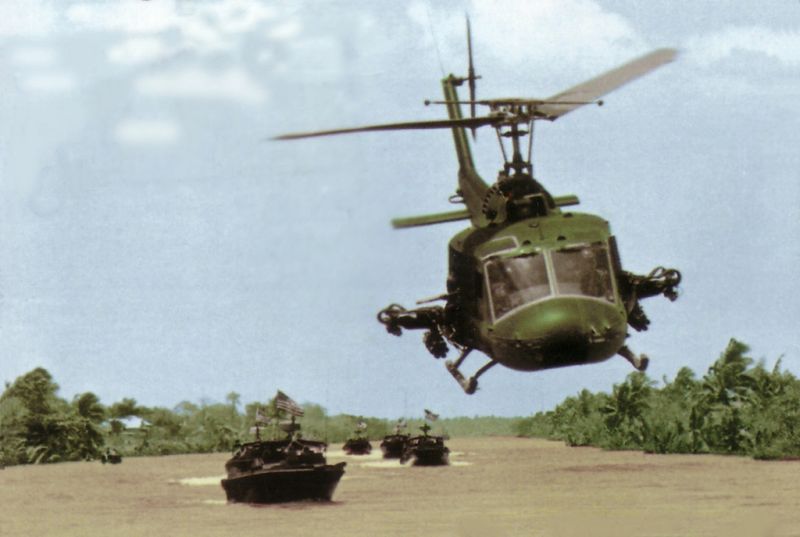
The Royal Australian Air Force also used Hueys in Vietnam, including a small number of Bushranger gunships. These were armed with two fixed forward-firing miniguns, rocket pods, and twin M60s on flexible mounts on the doors.
Huey models
As mentioned above, the Huey went through numerous iterations to meet changing needs. Here is a quick overview of the most important military versions.
UH-1A and UH-1B
The engine of the 1A turned out to be relatively weak despite the turboshaft construction, so the 1B was created to fix that and other teething problems. It had a stronger, 960 shp (shaft horsepower) engine, several structural modifications, and a longer cabin that accommodated seven passengers alongside the four crewmen (two in the cockpit, two for the door guns). When used for medevac, the 1B could carry four stretchers and a medic. Later production runs of the 1B had further improved 1,100 shp engines. Many 1B-s were converted to gunships once later, larger versions began taking over the troop transport role, but they never had the power to maintain their agility while carrying heavier armament.
UH-1C and 1M
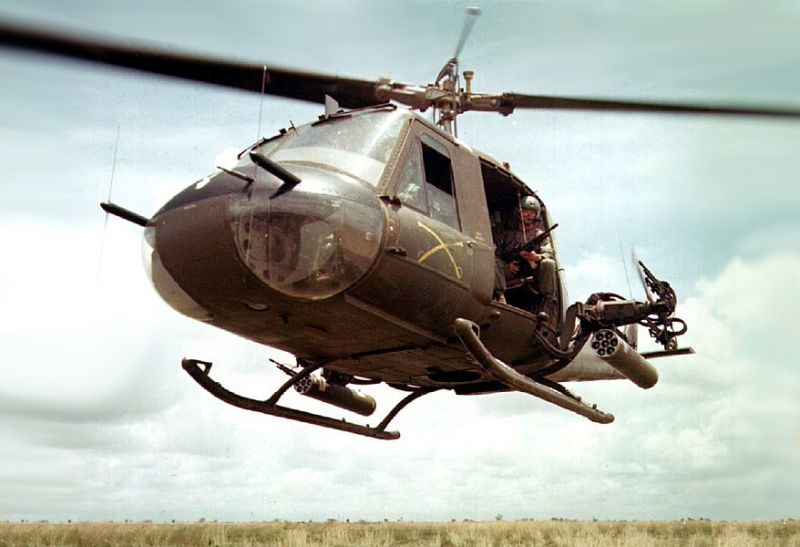
The 1C was designed specifically as a gunship. It had the stronger engine of the late 1B-s, and underwent some structural changes, got a dual hydraulic control system for redundancy against combat damage, an improved inlet filter for the dusty conditions of Southeast Asia, and increased fuel capacity. Later on, the 1C was given an even more powerful 1,400 shp engine under the 1M designation – the same engine was also used by transport helicopters in Vietnam, and the commonality simplified supply.
UH-1D and 1H
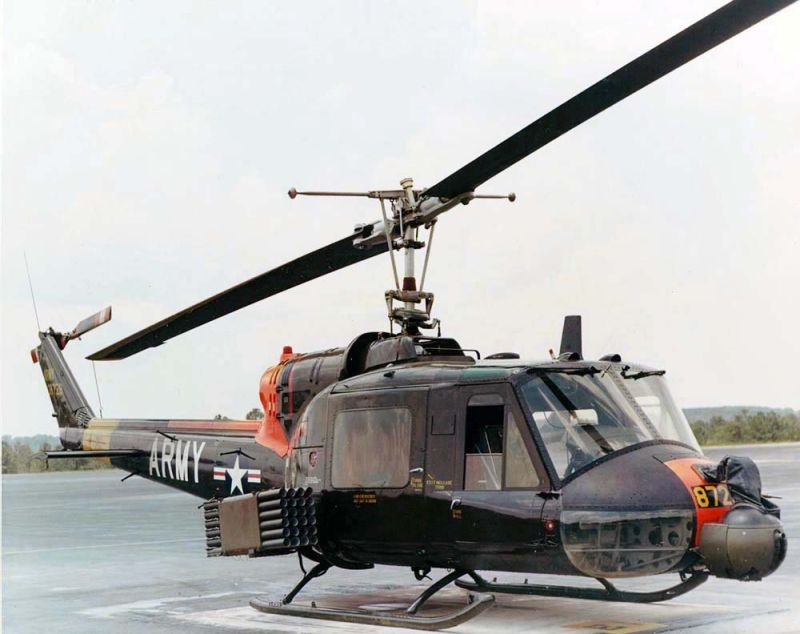
The Army wanted a Huey that could carry an entire infantry section of eight to ten people alongside the crew of four. Bell accomplished this by stretching the fuselage of the 1B by 41 inches (105 cm) and fitting in two sideways-facing seats, raising the total seating capacity (crew included) to 15. The larger interior space also made the 1D a better medevac aircraft, allowing it to carry six stretchers instead of four. The doors were replaced by wide ones, and a hinged panel was added to provide easier access for the cockpit crew.
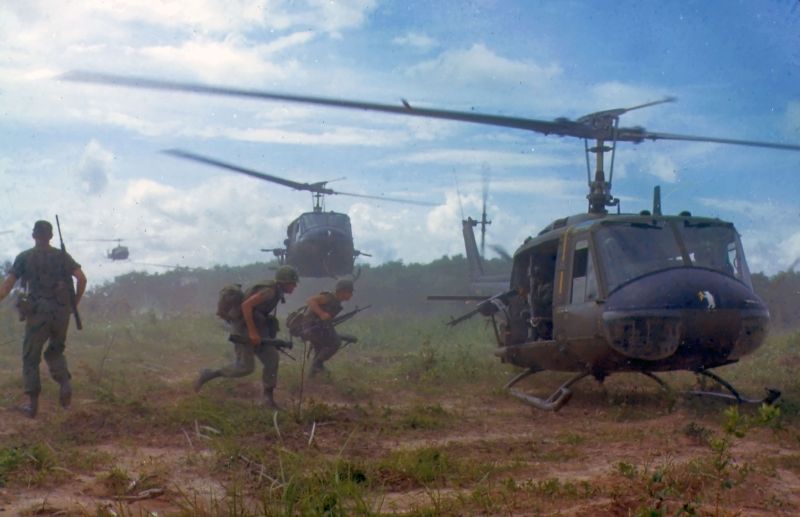
The 1D was also used as a base rescue / fire-fighting helicopter with 50 gallons of onboard water and foam. A later version with the 1,400 shp engine was designated 1H and became the most-produced version of the Huey, with many exported to other countries. The 1H lives on to this day in the Bell Huey II, a re-manufactured and modified military helicopter with a stronger engine, reduced vibration, an infrared countermeasures system and a cockpit compatible with night vision goggles.
UH-1E
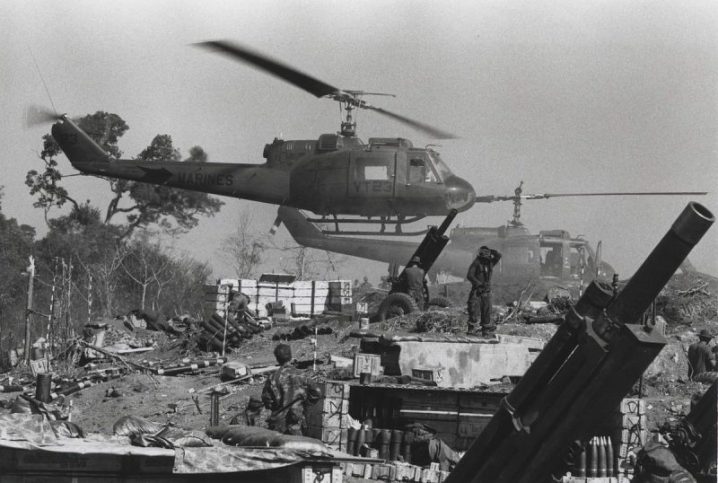
The Marines were a bit late to adopt the Huey – it's been speculated there might have been resistance against adopting Army technology, or maybe the Huey was slow to trickle down from the Navy. Either way, they decided to replace both their Cessna O-1 liaison and observation plane and their Kaman OH-43D search-and-rescue helicopter with a single new aircraft. The 1E, based on the 1B model, was designed to meet Marine requirements. Magnesium parts were replaced with more corrosion-resistant aluminum, special avionics compatible with Marine Corps ground frequencies were installed, a rotor brake was added so the rotor could be quickly stopped after landing on a ship, and a rescue hoist was mounted on the hoist.
UH-1F
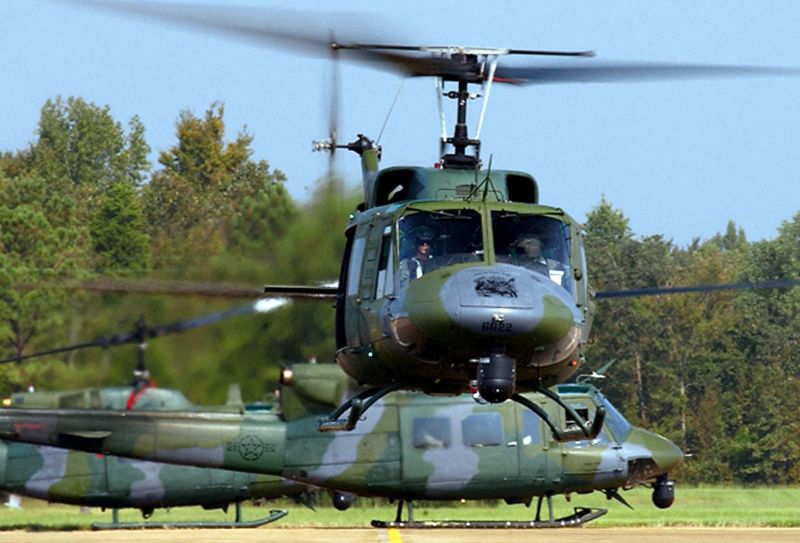
The 1F was adopted by the Air Force in 1963 for a very specific purpose: use as a support helicopter at missile bases. It was based on the 1B but had the longer tail boom of the 1D, and abandoned the Lycoming engine family in favor of the General Electric T-58 turboshaft, which was also used by the Sikorsky HH-3 "Jolly Green Giant" rescue helicopter, and the Air Force already had a large inventory of.
Twin Huey
Officially named UH-1N, the "Twin Huey" was born in 1968 when the Canadian government wanted to buy some Hueys but wanted them to have two engines for better performance. It has many Canadian-manufactured parts, including the Pratt & Whitney Canada PT6T engines, which made its adoption by the U.S. military a matter of controversy. In the end, the Marine Corps, the Navy and the Air Force (but not the Army) all ended up using it alongside the Canadian armed forces. The most immediately distinguishing feature of the Twin Huey is the rotor, which has four blades rather than two. The Twin Huey is still in service in some countries today, and its successor, the Bell UH-1Y Venom (or Super Huey) is still in service with the U.S. Marine Corps today and has seen action in Afghanistan and the 2015-19 U.S. intervention in Libya.
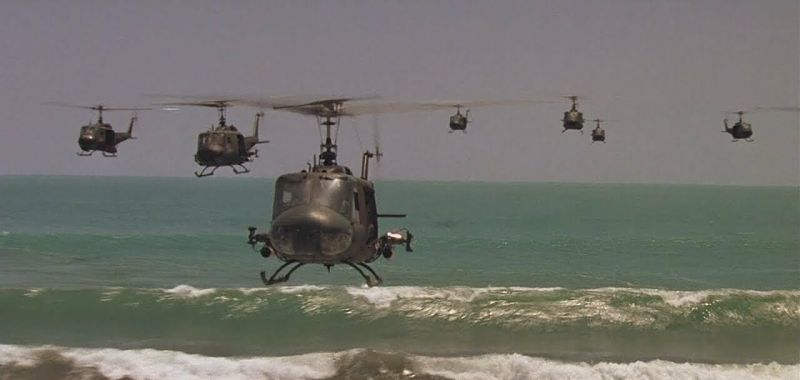
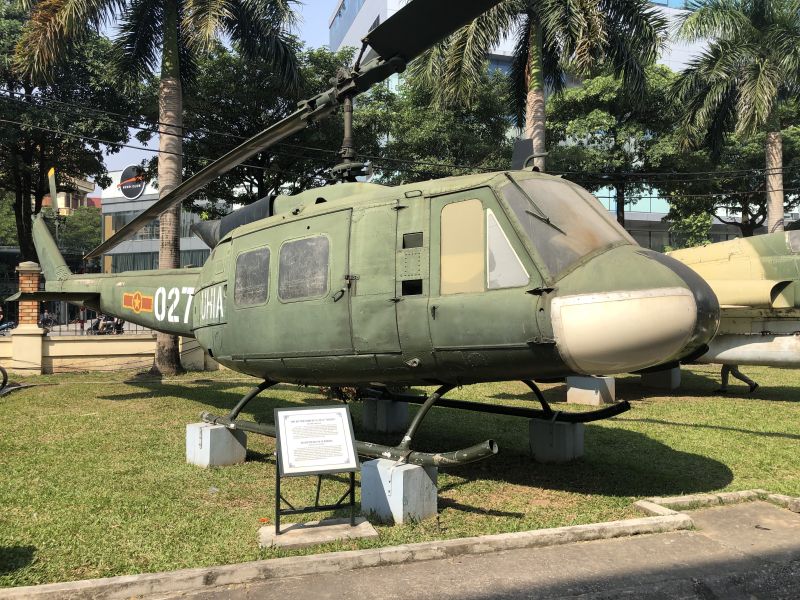
Over 16,000 Hueys were built over the long career of this helicopter. Versatile and dependable, it became one of the icons of American involvement in Vietnam, and left a mark on our cultural perception of the era. Movies set in the Vietnam War regularly feature them, most famously in the “Ride of the Valkyries” scene in Apocalypse Now. With many versions of the Huey family seeing non-combat service after the war, it is no surprise that you can still find many examples in museums. Our Britain at War, Third Reich and Vietnam War Tours all include visits to sites where you can find an original Huey on display.




Beaches of Normandy Tours
Beaches of Normandy Tours SAS, Normandy, France
Band of Brothers Tours
Band of Brothers Tours FZCO, Dubai, UAE