Beaches of
NormandyTours
NormandyTours
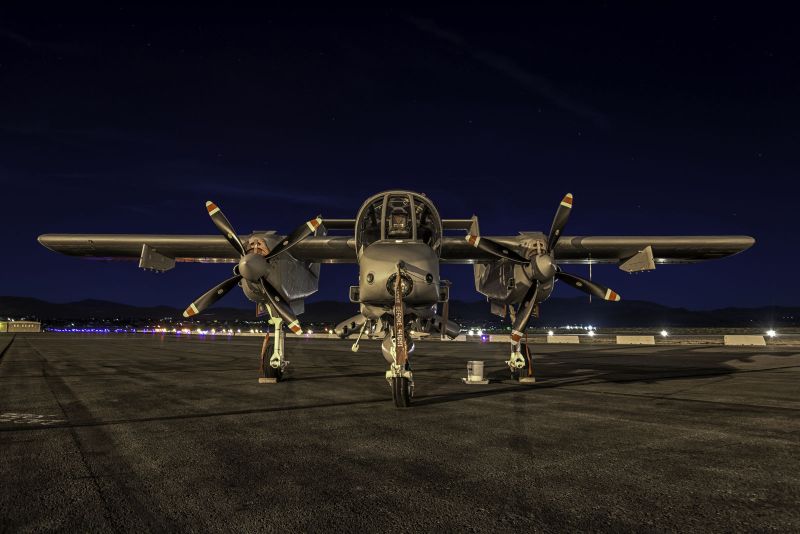
The Vietnam War presented challenges to the U.S. military it had not faced before. A large part of the war was not a World War II-style peer conflict between nations of comparable strength and traditional military structures. It was a counter-insurgency (COIN) operation, where one side, unable to challenge its enemy in traditional warfare, used insurgent methods: staying invisible, using the civilian population as a tool and a target, avoiding large-scale direct combat, and slowly eroding its adversary's will to continue. The North Vietnamese Army did represent a traditional threat, but the Viet Cong's guerrilla warfare forced the U.S. to adopt new tools and techniques. One of the results of this adaptation was the OV-10 Bronco, America's first dedicated COIN warplane.
The need for counter-insurgency planes
One of the fundamental problems of COIN operations is that insurgents are very good at not being found. They operate in small groups, blend in with the civilian population, and make use of hard-to-traverse terrain, such as the hilly jungles of Vietnam, where their traditionally powerful enemy can't get to them.
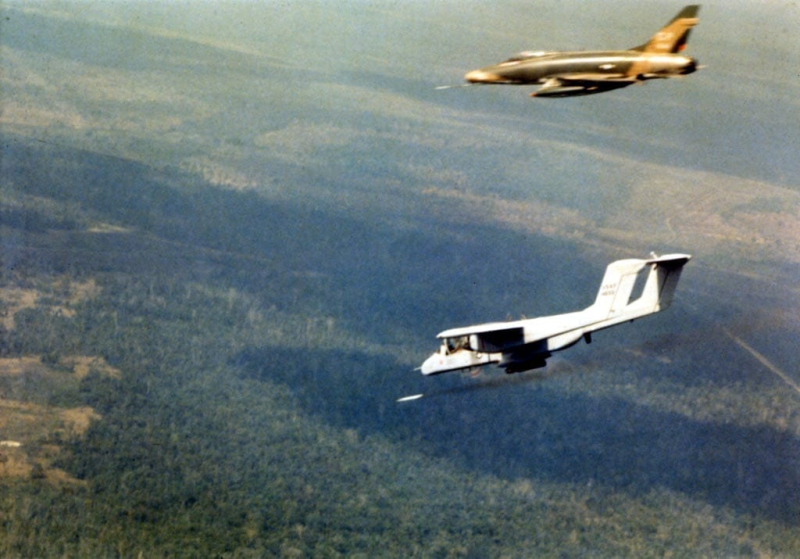
Aircraft can be blessing when you're on the side trying to put down an insurgency, since they can fly over large areas of extremely rough ground where infantry or ground vehicle patrols would be inefficient or downright impossible. Once the enemy is found, the plane can radio in their location for artillery strikes, air strikes or air assault by helicopter-borne infantry. You do, however, need the right kind of plane for the job. The plane needs to stay in the air for a long time to cover sufficient ground, and to stay over the target and call in adjustments to artillery fire. A jet plane, while very fast, can't do that, as it runs out of fuel too quickly; therefore, you want a propeller craft which is slower but more fuel-efficient with a longer loiter time over the target. You also want it to be light, to further save on fuel consumption, and to carry some armament, perhaps not enough in a peer conflict, but good enough to attack insurgents with. Since insurgents (at least during the Vietnam War) did not usually have very good anti-aircraft armament, you can skimp on armor to a degree, making your plane all the lighter. You also want the plane to be as cheap as possible, as COIN operations do not have the same political and economic support as a full-scale existential war.
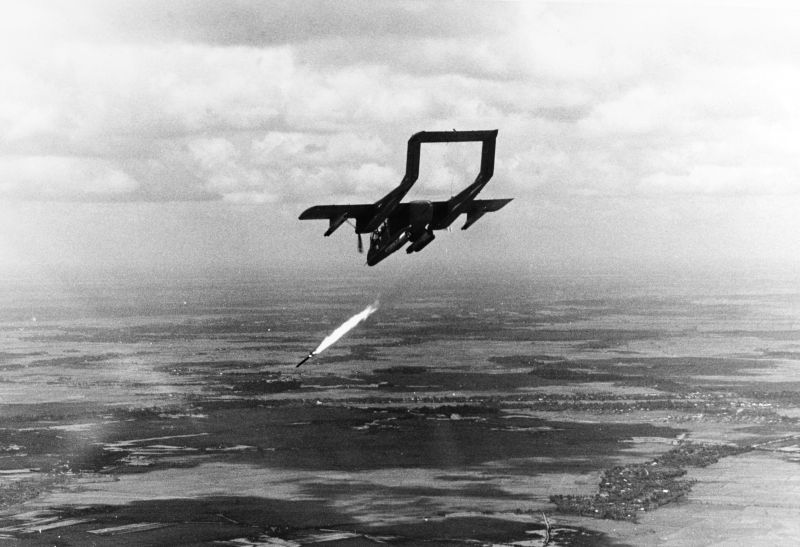
Now, the idea of COIN aircraft was not new in Vietnam. Imperial powers such as Britain had already used planes in such roles in Africa and the Near East in the 1920s and 30s. At first, however, these aircraft were not purpose-designed; they were just regular planes, usually transports and bombers. France designed the Potez 75, a plane specifically created for COIN purposes, in the 1950s. The U.S. Army, aware of the need for such planes, tested several designs in the early 1960s, but the tests went nowhere as the Army was prohibited from using fixed-wing aircraft in combat. In the early days of Vietnam, the military was stuck with sometimes hastily modified versions of already existing planes for COIN operations.
Creation of the Bronco
The OV-10 Bronco, the first dedicated American COIN warplane to enter service, owes its existence to two Marines: W. H. Beckett and Colonel K. P. Rice. Beckett and Rice were neighbors in Santa Ana, California, and would often sit on Beckett's patio and talk about aviation trends. They lamented what they considered the neglect of traditional close air support platforms in favor of jet-based "boom and zoom" tactics, and decided to do something about it. With a directness befitting Marines, they decided they would simply build the plane they thought the U.S. needed.
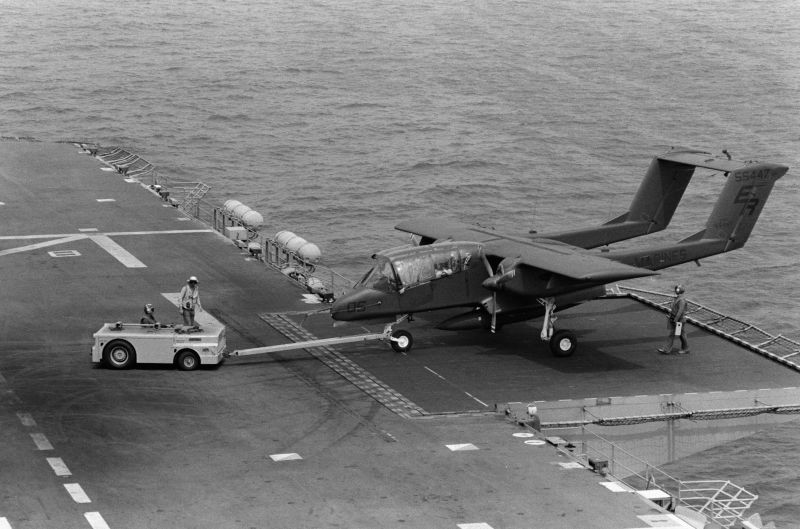
Their design was a scrappy observation plane that also mounted enough armament to attack the enemy on the spot. It was a twin-engine turboprop, faster than helicopters, but slower, more fuel-efficient and with longer loiter time than jets. The weapons were mounted close to the centerline to make aiming easy. It was also capable of taking off from and landing at small, primitive forward bases right in the combat area. Beckett and Rice built most of the full-scale fiberglass model in Rice's garage, though the place was too small to accommodate the wings.
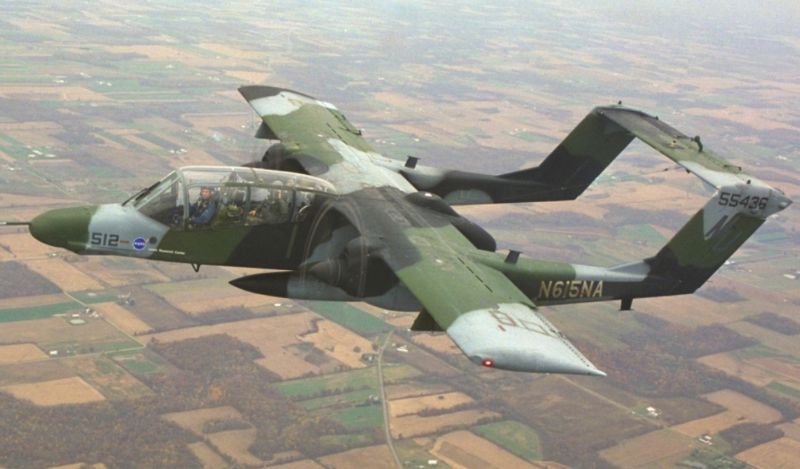
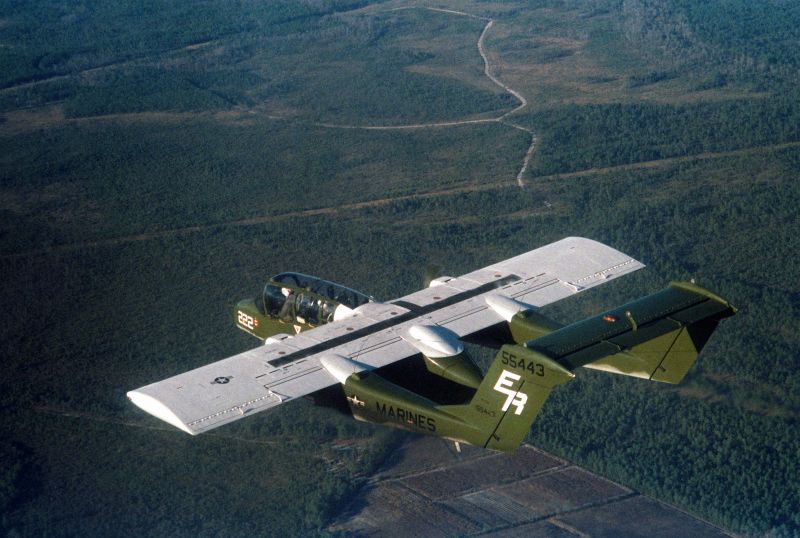
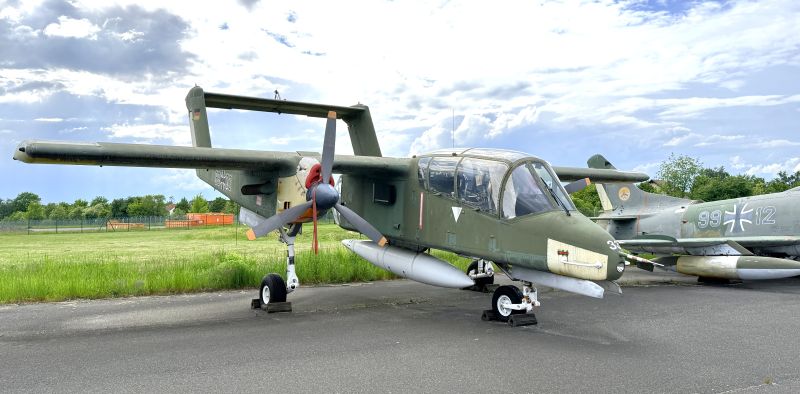
The design had a distinct look a bit reminiscent of the P-38 Lightning (Like Lightning From a Clear Sky): it had a central nacelle for the two-man crew and the cargo, twin booms for the turboprop engines, and a prominent shared horizontal stabilizer in the tail.
The designers received some enthusiastic support, produced a flier for their plane, and Beckett, who had retired from the Corps by the time, went to work at North American Aviation to sell the aircraft. The design underwent further changes at North American, and ended up being much larger and more complicated than originally envisioned, receiving the NA-300 designation.
Fortunately for Beckett and Rice, the military happened to be looking for something just like that. A Navy-Army-Air Force "tri-service" specification for a Light Armed Reconnaissance Aircraft ("LARA") was issued in 1963. The LARA project was about creating a versatile, "jungle-fighting" observation and light attack aircraft to replace the Cessna O-1 Bird Dog and O-2 Skymaster observation planes which were perceived as slow and having too small a load capacity. The LARA plane was required to have a crew of two, two engines, a cargo load of 2,400 lb (1,100 kg) or six paratroopers, a minimum speed of 350 mph (560 km/h), basic aerobatic ability, and the capability for an amphibious conversion. It also had to carry a variety of armament options including four 7.62 mm machine guns, external gun and rocket pods and AIM-9 Sidewinder air-to-air missiles. It had to be able to take off from and land on carriers. At some point, the requisite of using jungle roads as runways was considered, but some sources claim the final version of the plane was too wide for that.
Eleven proposals were submitted and the NA-300 came out on top in August 1964. The plane was named the OV-10 Bronco in military service; the "O" stands for "observation vehicle," the "V" for "short takeoff and landing." 360 were built over time – a small number compared to the production runs of World War II, but the Bronco still remained the premier COIN aircraft for 30 years.
Abilities of the Bronco
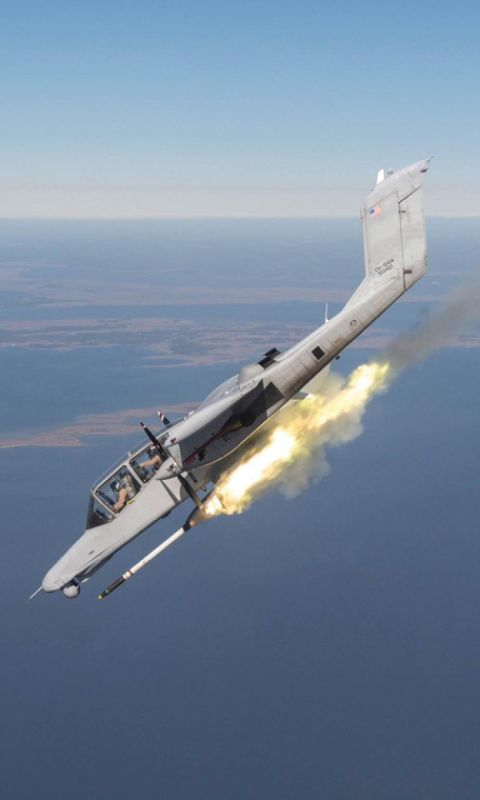
The Bronco was cheap, sturdy, and a true multi-purpose aircraft. It could do observation, artillery spotting, aerial forward air control (guiding other strike craft to the correct target), helicopter escort, armed recon, low-level aerial photography and light ground attack. It could carry light cargo, a small number of paratroopers or stretchers with wounded, and it could stay in the air for 5 and a half hours with external fuel tanks. The cockpit had a large, bulbous “greenhouse” that was wider than the fuselage and afforded excellent all-around view. The plane’s main armament was four 7.62 mm machine guns, or, in some models, one 20 mm electric cannon, supplemented by seven hardpoints that could carry rockets, bombs, Sidewinders or flares. Seismic sensors could also be dropped from the air near Viet Cong paths and would then automatically detect and transmit the rumble of trucks and troop formation. One prototype designed to lay ground-level smoke was so popular with the evaluating unit that they only gave it back reluctantly, and were probably sad to hear it didn't go into full production as top brass did not see a mission for it.
While a very good plane, the Bronco was not perfect, and struggled with low-powered engines. Its official ceiling was 26,000 ft (7,900 m), but in actual practice it rarely went above 10,000 (3,050 m) and never above 18,000 (5,490 m). It advertised ability to take off with only 800 ft (244 m) of runway without catapults was only true under optimal conditions. Some Broncos have crashed when they failed to pull up while approaching a steep hillside. Another, unrelated weakness was ditching in water: no Bronco pilot has survived such an attempt, though at least one backseater was rescued by a helicopter in time.
The Bronco's service history
The Bronco saw used with the with Marines, the Air Force and the Navy. The Marines were the first to adopt the plane, and started flying missions in July 1968. Marine Broncos often flew missions from six in the morning till after sunset, and each unit had a "hot pad" with a plane ready to take off. The crewmen would sleep under the plane's wing on particularly action-heavy nights, and the backseater would have a little plastic sheet hanging from a lanyard around his neck with the last known coordinates of ground-based recon teams. If a particular team got in trouble and radioed for support, he would just look at the sheet and immediately know where to go. The Marine backseaters were not aviators; they were infantry, artillery or tank officers who were better at communicating with troops on the ground.
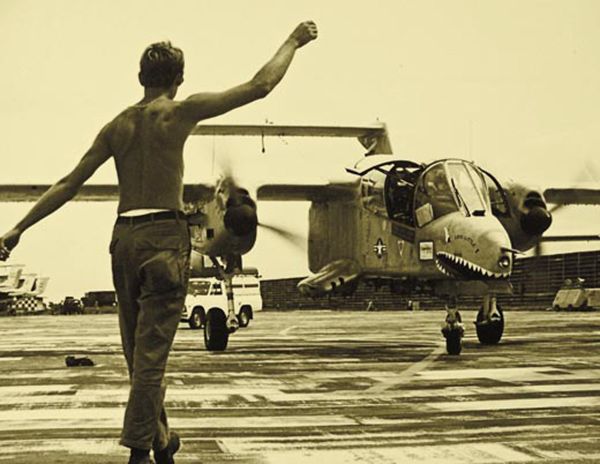
Some Marine Broncos were outfitted with laser designator pods and LORAN (Long Range Navigation) systems in 1971. These cooperated with McDonnell F-4 Phantoms in interdicting the Ho Chi Minh Trail, the secret North Vietnamese supply route running through Laos and Cambodia. The laser designator would illuminate targets, the LORAN would "translate" the target's location to specific coordinates, and the laser-guide bombs from the Phantom would follow the electronic trail and strike unerringly.
Marine Broncos flew patrols even on days without action to familiarize the crews with the area. Over time, the men got to know the ground so well they could tell from the air if a particular river crossing had been used or the vegetation changed in the last few days.
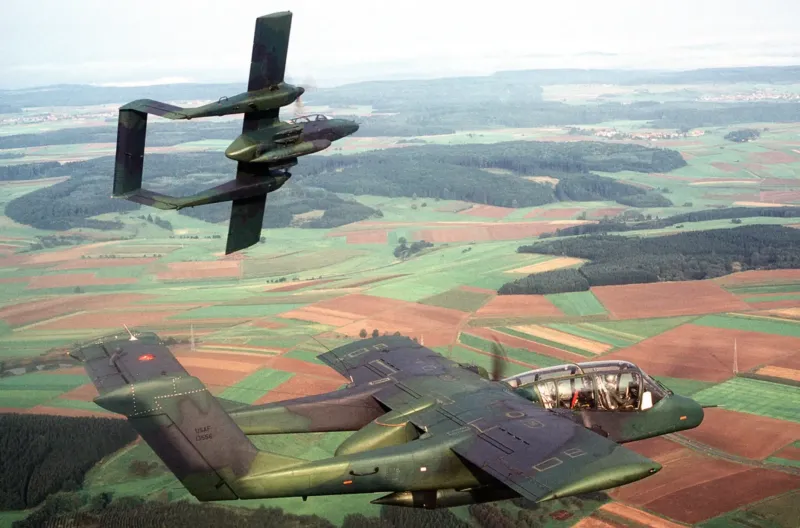
The Air Force started flying combat missions with their Broncos a month after the Marines, and used the plane for a variety of forward air control roles including day- and nighttime strike direction, gunship direction, bomb damage assessment, visual recon, and aerial artillery direction. Air Force VO-10s also flew as escorts for planes carrying chemical weapons as part of Operation Ranch Hand, the herbicidal warfare project that employed chemicals such as Agent Orange. Some Air Force Broncos were flown by Australian and New Zealand crews attached to U.S. squadrons.
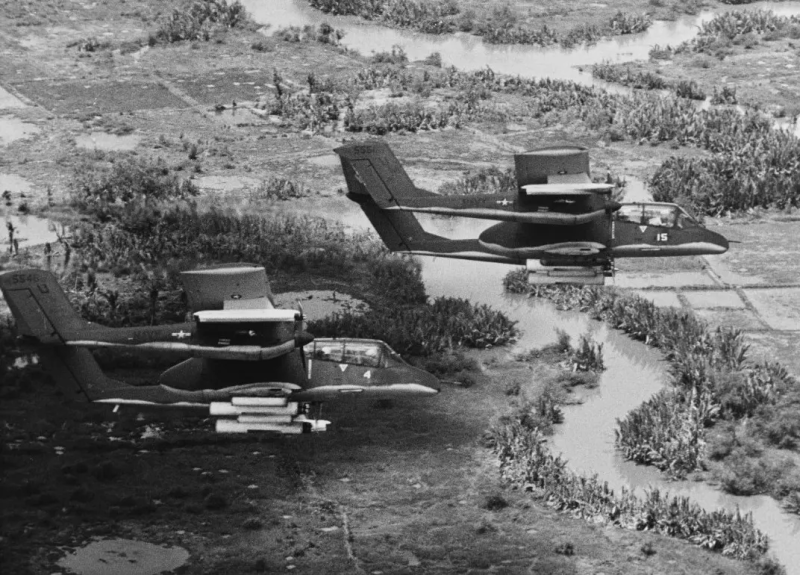
The Navy operated Light Attack Squadron Four (“VAL-4”), the Black Ponies, in Vietnam from April 1969 to April 1972. They were typically used as light ground attack craft to interdict enemy logistics and support Marines, Navy SEALS and riverine boats. The unit was decommissioned shortly after the end of the war, and the remaining Broncos transferred to the Marines.
Broncos continued to see U.S. military service into the 21st century. The Air Force flew two OV-10s over Iraq and Syria in 2015, flying over 120 combat sorties in 82 days, reportedly providing support for Special Forces missions. The Navy also flew two Broncos over Iraq in the same year, flying 120 sorties.
Foreign and non-military service
The Bronco proved itself an effective COIN aircraft in Vietnam, and it's no surprise that other nations, some dealing with their own internal struggles, lined up as buyers. Columbia, Indonesia, Morocco, the Philippines and Thailand all flew the plane in this role at some points between the seventies and 2024, while West Germany used a modified version as an aerial target tug. The Indonesian Broncos were unique in that they were modified to carry Soviet rockets and bombs, as American ones were not available during the first few years of their service. In Venezuela, several Broncos changed sides, so to speak, and were flown by mutinous officers in an attempted coup d'etat against the government in 1991. They attacked police and government buildings in Caracas with bombs and rockets, but four were lost to a single loyalist F-16 Fighting Falcon.
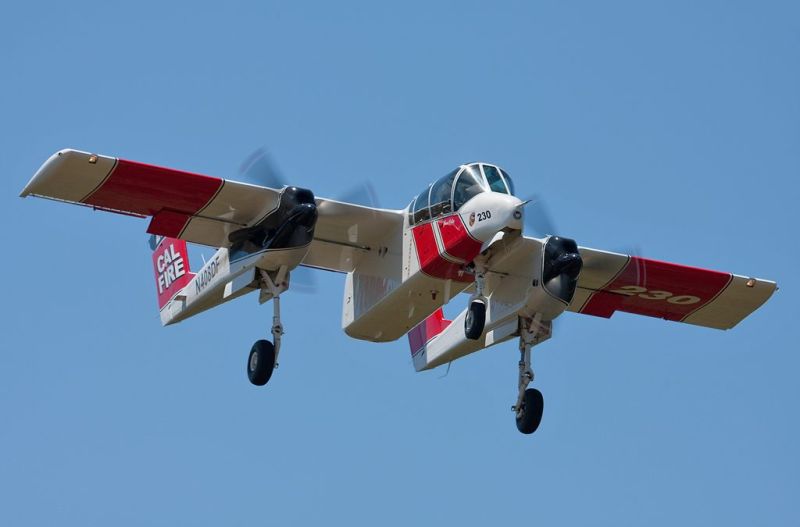
Domestically, the Bronco had been used by the Department of State in drug interdiction and eradication efforts in South America, flying with civilian registration numbers and Kevlar armor padding around the cockpit, carrying herbicide in a hopper tank. The Bureau of Land Management and the California Department of Forestry and Fire Protection have used (and the latter still uses) Broncos as firefighting planes, leading firefighting air tankers and coordinating aerial assets with the commander on the ground. NASA has also used Broncos, some handed down by the Department of State, for studies involving low-speed flight, noise and turbulence, and, according to some sources, experiments involving flying into lightning storms.
If you’d like to see a surviving Bronco, you can do so on our Third Reich Tour or Britain at War Tour.


Beaches of Normandy Tours
Beaches of Normandy Tours SAS, Normandy, France
Band of Brothers Tours
Band of Brothers Tours FZCO, Dubai, UAE