The giants of the landing craft familyA Landing Craft Tank visited on our Britain at War Tour (Photo: Author’s own) Amphibious landings on contested beaches were a recurring and perilous event in World War II, and it is no surprise that a variety of vessels had been developed for such operations. The American LCVP, better known as the Higgins boat (The Higgins Boat), and the British Landing Craft Assault (LCA) (Landing Craft Assault) were just two examples of such specialized vehicles. Today's article will look at another member of the family: the hulking Landing Craft Tank (LCT). Smaller boats were designed to carry infantry and maybe a jeep, while the even larger LST (Landing Ship, Tank) could not usually land tanks directly onto the shore (unless it deliberately beached, but then it was stuck until the next high tide); the LCT bridged the gap by carrying tanks right onto a contested beach so they could help the infantry with securing a foothold.
Origins of the LCT
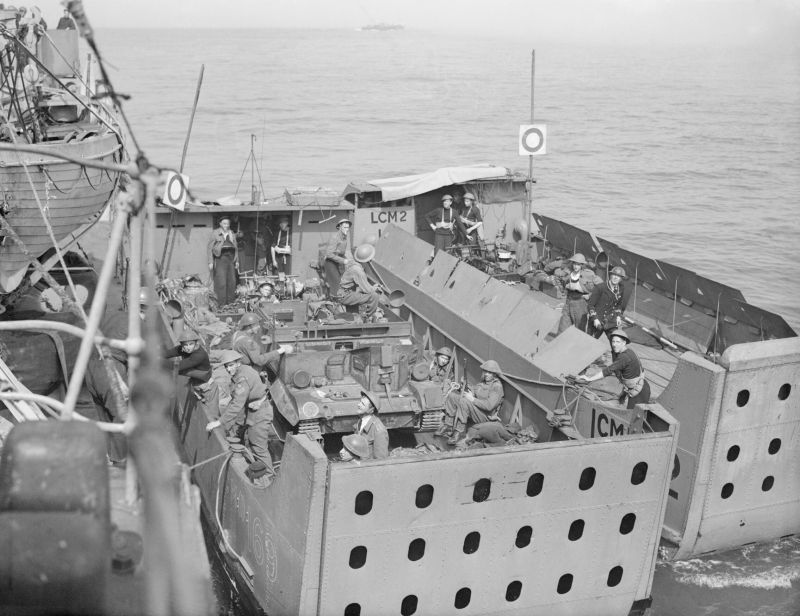
Like the LCA, the LCT was also a British design, and was based on earlier interwar experiments. The disastrous Gallipoli Campaign of World War I, in which large numbers of British and ANZAC troops made amphibious landings and then failed to fight their way inland in the face of heavy Ottoman defense demonstrated the need for custom-designed landing craft. Initial disagreement between the Army and the Royal Navy over who should pay for construction and post-war economic depression delayed the introduction of such a craft until 1926, when the Motor Landing Craft (MLC) first sailed, followed by the Landing Craft, Mechanised Mark 1 (LCM (1)) in 1938. These had a loaded speed of about 6 knots (7 mph), and could carry a single tank. Two LCM(1) vessels during the Dieppe Raid (Photo: Imperial War Museums) Only nine MLCs had ever been built; six of them were based in England when World War II broke out, and three in Malta. (The Siege of Malta) Both MLCs and LCMs were used in the same operation in April 1940 that was also the debut of the LCA, landing troops and vehicles behind German lines during the invasion of Norway. (The German Invasion of Norway) They also participated in the Dunkirk evacuation, and LCMs were used in many other operations, both commando and otherwise.
Development of a better and bigger tank landing craft began at the insistence of Prime Minister Winston Churchill (Churchill – Part I) (Part - II), who wrote in a December 1940 memo"Let there be built great ships which can cast upon a beach, in any weather, large numbers of the heaviest tanks." At the time, "heaviest tanks" meant 40 tons, which was the weight of the heavily armored Churchill tank (The Tortoise in the Race) already under development and soon to enter service.
LCT versions
Mark 1
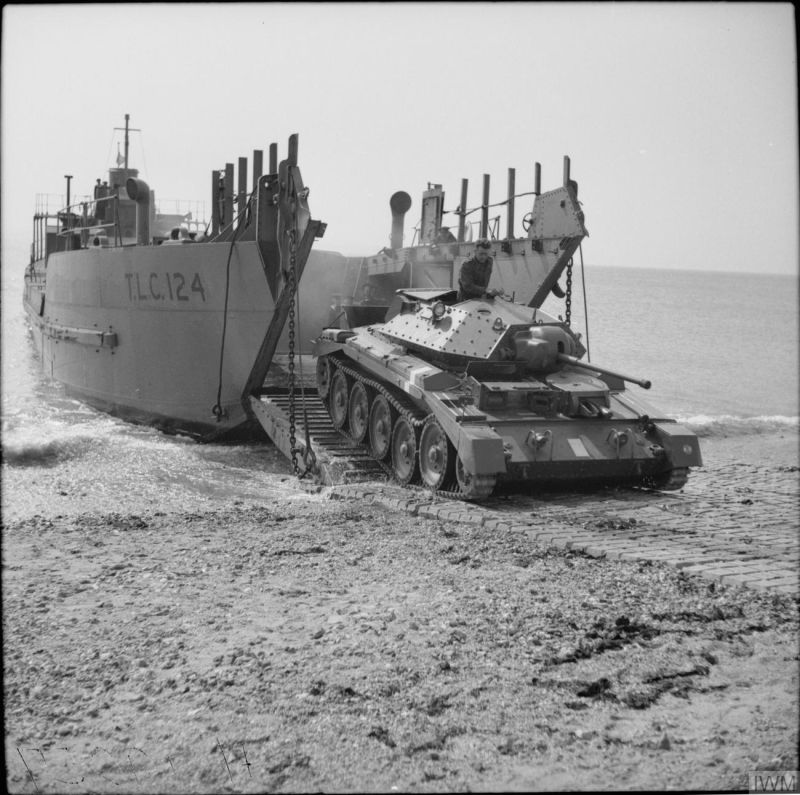
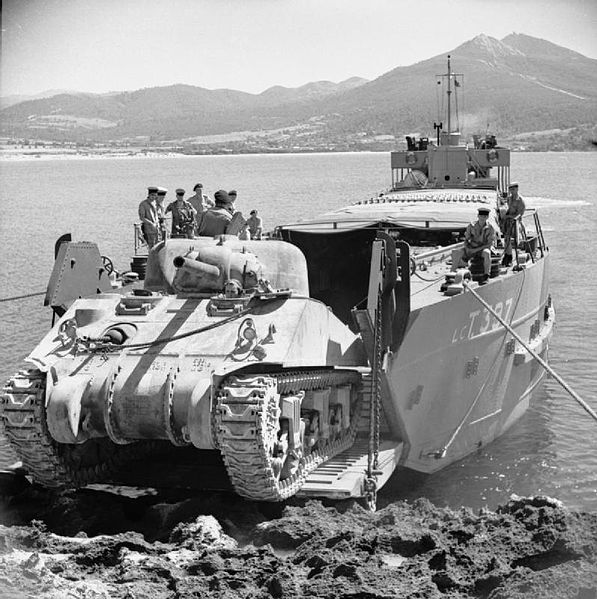
The resulting design was original called Tank Landing Craft, "TLC," and like the LCA, was later changed "Landing Craft Tank" to bring in it line with joint British-American naming conventions. It was 152 ft (46 m) long, 29 ft (8.8 m) wide, and had an aft draft of 5.9 ft (1.75 m). The front draft was much smaller, and the vessel could discharge tanks into 2 ft 6 in (0.76 m) of water on a 1:35 gradient beach. The deck on which the tanks were carried was below the waterline, so tanks first had to roll up an incline before they could make it through the doors and down the ramp onto the beach. One vessel could carry three heavy 40-ton tanks like the Churchill, or six smaller tanks such as the British Mark VI Light Tank or the later American Stuart, in three rows of two tanks pair row. The two 500 horsepower U.S.-built Hall-Scott engines gave the landing craft a speed of 10 knots (12 mph), but it suffered from a relatively short range of 1,000 miles (1,700 km).30 Mark 1's were built and mainly saw action in the Mediterranean. Each had a crew of 2 officers and 10 enlisted men, and was armed with two "pom-poms," British quick-firing 2-pounder anti-aircraft guns. Each vessel was assembled in four sections, and could be carried to its theater of operations by a transport ship in pieces. A Crusader tank rolling off an LCT (still designated “TLC” on the photo during the test of a portable concrete roadway, 1942 (Photo: Imperial War Museums)
Mark 2
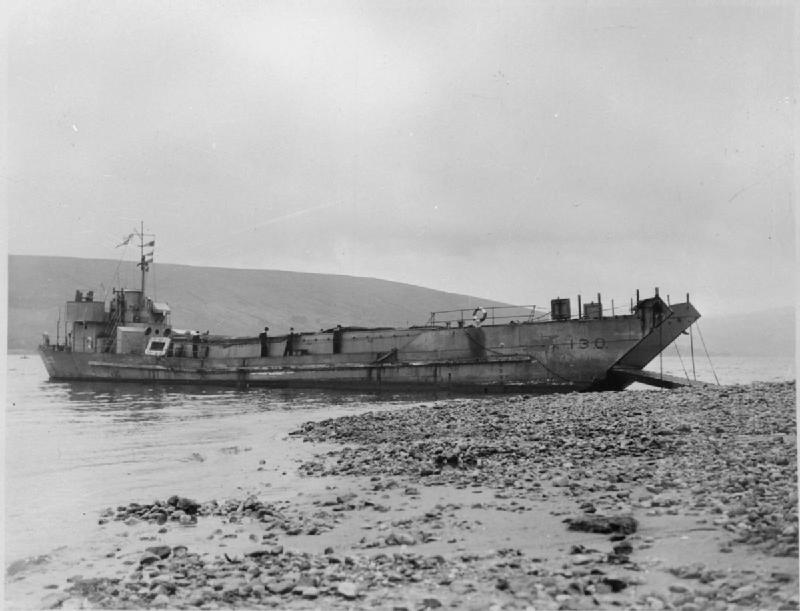
The Mark 2, introduced in 1941, was slightly larger: it was 7 ft 11 in longer and had a 1 foot wider beam. This might seem like a modest increase, but the more efficient use of space allowed the boat to carry seven Valentine infantry tanks, while the older version could only carry three. Alternatively, it could carry three 50-ton, four 40-ton or five 30-ton tanks, or nine trucks. The Hall-Scott engines were in great demand by Royal Navy's Coastal Forces division, which mainly operated motor torpedo boats, so the Mark 2 LCT was initially equipped with three Napier Lion engines instead. Three sets of running gear per boat turned out to place too much strain on supplies, so the Napier Lions were eventually swapped for two 500 hp Paxman engines per vessel. This resulted in a slight speed increase over the Mark 1, but the massive range increase proved far more important: with a range of 3,100 miles (5,000 km), a Mark 2 could have theoretically departed from any part of the British isles and transported its cargo to the Normandy beaches on D-Day at full speed without stopping for fuel – and could have still made it back to its departure point. The pom-pom anti-aircraft guns were replaced by two 40mm Bofors anti-aircraft autocannons on some of 73 Mark 2-s built. A Mark 2 beaches in Scotland (Photo: Imperial War Museums) It was becoming clear by this point that a very large number of landing craft were going to be needed for the war, and, like with many other pieces of gear, British industry was struggling to keep up with demand. Structural steelwork firms were added to the program: they would prefabricate the structural elements, which were then often assembled at shipyards that were shut down before the war but opened again.
Mark 3
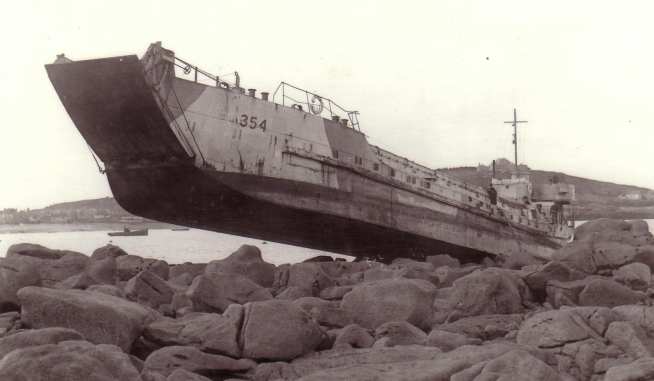
The Mark 3 began as an experiment and a proposal initiated not by the military, but a ship builder. A fifth hull section was added to the middle of the vessel, increasing its length by 32 ft (9.8 m). The extra length allowed it to carry five Churchill, six or eight Valentines or Shermans (The M4 Sherman), or 11 light tanks. The extra cargo load was achieved without compromising on range or speed (after some initial attempts). The armament of the vessel was supplemented by the "Fast Aerial Mine Apparatus," which was a fancy name for an anti-aircraft rocket launcher. 235 Mark 3-s were built. A thoroughly beached Mark III (Photo: combinedops.com)
Mark 4
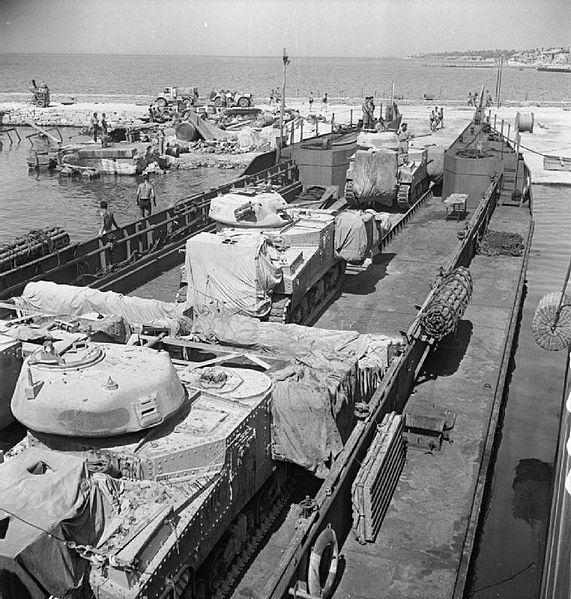
The 865 Mark 4-s were shorter than their immediate predecessor by about 5 feet, but compensated for it with a significantly wide beam: 38 ft 9 in (11.81 m) instead of 30 ft (9.1 m). The extra width not increased not only cargo capacity, but also buoyancy, giving the vessel a front draft of 3 ft 8 in (1.12 m) and an aft draft of 4 ft (1.2 m). This was achieved partially by raising the tank deck above sea level, and enabled the vessel to land on shallower beaches than any of its predecessors, making it especially suited for the Normandy invasion. It could carry five Churchills or nine Shermans and was the largest British-built LCT version. The extra cargo capacity came with a sacrifice in range: 1,240 miles (2,000 km), less than half of the Mark 3. M3 Grant tanks rolling off a Mark 4 in North Africa (Photo: naval-encyclopedia.com) The Mark 4 did away with the earlier modular construction scheme. Instead, it came in prefabricated kits that were assembled in riverside yards, freeing up saltwater shipyards for other work. The structural changes made this version more fragile than its predecessors, and a number of Mark 4-s broke their back when hitting an uneven beach or heavy waves at sea. The design was eventually stiffened to make it sturdier, and the Mark 4 was considered a very good vessel other this one flaw. Some Mark 4-s were transported to India and participated in late operations in Burma in 1945. The Mark 4 first saw combat in the Dieppe Raid (The Dieppe Raid); it was found to lack maneuverability due to its length, and later versions, built in the USA, were significantly shortened.
Mark 5
The Mark 5, or LCT(5), was the first American-built LCT., beginning service in 1942. The U.S. entered the war without having much in the way of landing craft, and while the Higgins boat turned out to be great for putting infantry ashore, they did not have a larger ship for tanks. The British offered one of their own designs as a sort of "reverse Lend-Lease." At 117 ft 6 in (35.8 m) long, it was much shorter than British LCT's, and its three 225 hp Gray Marine engines still sacrificed some speed and quite a bit of range. Unlike the Mark 4 and like earlier versions, it was built in sections, three of them due to its smaller size. If it was necessary, the three sections could be lowered into the sea from a transport ship separately and bolted together in the water. Despite the smaller size, it could still carry four 40-ton or five 30-ton tanks. 172 of the 470 Mark 5-sended up in British service. A Sherman debarking from a Mark 5 in North Africa, 1943 (Photo: naval-encyclopedia.com)
Mark 6
While very similar in size to the Mark 5, the similarly American-built LCT(6) improved the deck layout by placing the wheelhouse, the anti-aircraft guns and the engines further out to the side, freeing up more space in the center. The anti-aircraft guns were supplemented by up to four .50 caliber Browning machine guns. (The Browning .50 Cal) 960 Mark 6-s very built, some of which ended up in British or even Soviet service. Some saw service in Korea, several were converted for Arctic service, and a few were used by the South Vietnamese forces during the Vietnam War. Yet others were used as targets in the 1946 Bikini Atoll nuclear tests.
Mark 7 or LSM
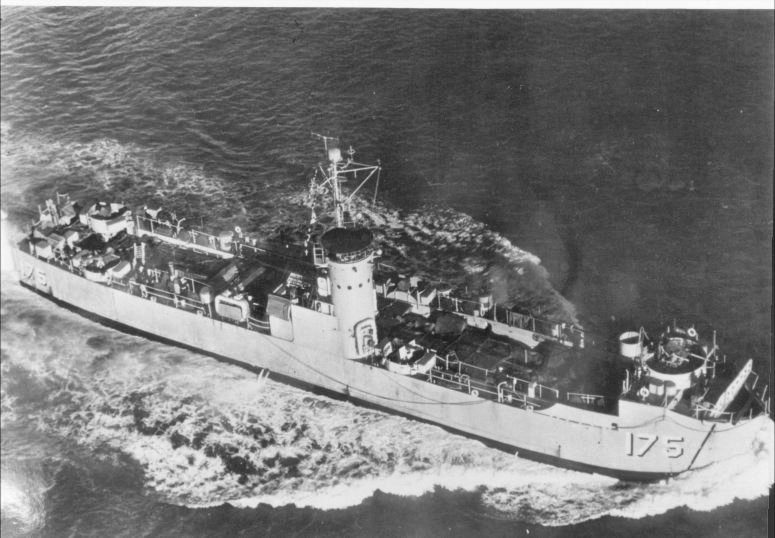
The Mark 7, another U.S. design, ended up abandoning the "LCT" name. It was designed to be significantly larger than previous American (or, in fact, British) versions, and be capable of transporting both tanks and infantry. It ended up being 203 ft 6 in (70 m) in length, which put it over the 200 ft limit that separated "craft" from "ship." Therefore, it was designated Landing Ship, Medium, or LSM. USS Oceanside, formerly LSM-175 (Photo: navsource.net) The 558 LSM-s were mostly used as regular transport craft in the Pacific, though several dozen were converted to specialized roles. Each ship could carry five medium or three heavy tanks, six Landing Vehicle, Tracked (LVT) landing craft, or 9 DUKW-s (The American "Duck") along with 54 soldiers. Appropriate for a ship of such a size, its anti-aircraft armament was expanded to comprise up to two 40 mm guns and up to 6 20 mm ones. Most ships were scrapped during the Cold War, though some were sold to private companies and foreign nations.
Mark 8
The last LCT to be produced was another British version. In late 1943, the Director of Naval Construction was instructed to prepare plans for an LCT design specifically for service in the Far East. It had to be able to operate over significantly longer ranges than what was required in Europe, had to have improved seakeeping for use on the open ocean, and needed the speed to keep up with convoys of Landing Ship, Infantry vessels. The design and capabilities were influenced by the American LSM, and the Mark 8 combined the best qualities of earlier versions: it had the bow layout of the Mark 2, the robustness of the Mark 3, and the light construction and mass-production capability of the Mark 4. It was 231 ft (70.5 m) long and 38 ft (12 m) wide, and its four engines driving two propeller shafts with a total power of 1,840 hp gave it a cruising speed of 9.2 mph (15 km/h) and a range of 4,600 miles (7,400 km). It was designed to operate with a crew of 25, but this was eventually raised to 37 by the late 1960s. It could carry eight 30-ton tanks or 13 fully loaded 3-ton trucks, along with 42 passengers, typically the crews of the vehicles on board. HMAV Abbeville (L4041), a Mark 8, in 1977 (Photo: Medcroft / Wikipedia) 187 Mark 8-s were ordered, but only 30 were completed for military use, with another 6 sold to civilian buyers. Ten vessels, one operating with a civilian crew, served in the Suez Crisis of 1956, and several others were deployed in 1962 to the Indonesian Confrontation, a three-and-a-half-year war between Communist-supported Indonesia and the newly independent and Western-supported country of Malaysia.
An even larger Mark 9 was considered, but the plans were never finalized.
Modifications
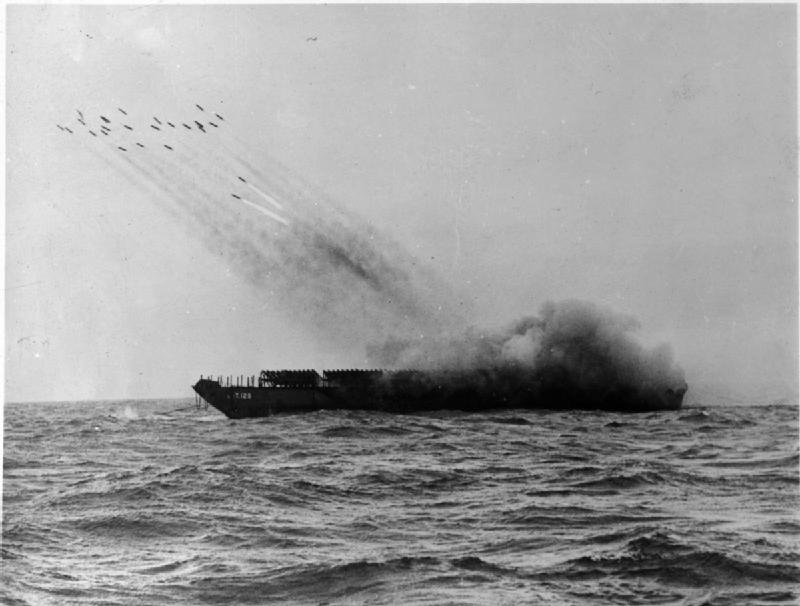
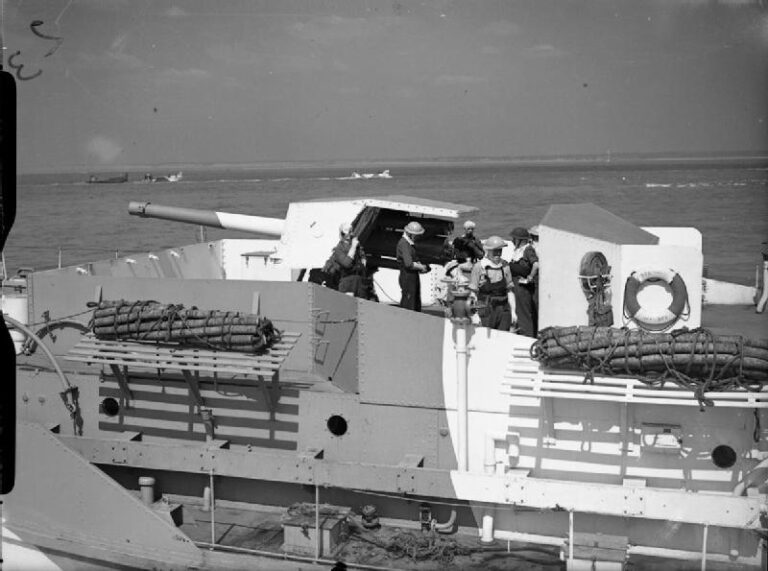
A number of LCT-s were converted and used for special purposes, mostly during the Normandy landings. The Landing Craft (Rocket) or LCT(R) was an old Mark 2 or 3 with its loading door welded shut and a second deck installed above the tank bay. This top deck was then used to mount either 972 or 1044 rockets that could be fired in approximately 24 salvos. A rangefinding radar was also installed, and doubled as a navigation aid. The rocket salvos could be triggered remotely from the bridge, while the rest of the crew took shelter under the deck. The rockets could blanket an area some 1,000 yards (910 m) in depth. Both the British and the Americans used the rocket ships in Normandy, and they also served in the Mediterranean and the Far East. An LCT(R) firing a rocket salvo (Photo: Imperial War Museums) Landing Craft Guns (Large) or LCG(L) was a variant converted from Mark 3-s and 4-s, armed with two British QF (quick firing) 4.7 inch guns, eight Oerlikon AA guns and two pom-poms. They were used in Normandy to provide longer-range fire support than the LCT(R)-s. The main armament of an LCG(L) (Photo: naval-encyclopedia.com) Landing Craft Tank (Armored) or LCT(A) Mark 5-s with additional armor on the bow and the crew stations, designed to hit the beach with the very first wave. They had a heavy wooden ramp inside near the bow; two tanks could roll up on the ramp to stick their guns over the wall and fire at targets on the shore.
The Landing Craft Tank (self-propelled) or LCT(SP) carried self-propelled guns onboard to provide offshore support fire. The U.S. version had 155 mm guns onboard, while the British one, named Landing Craft (High Explosive) had U.S.-made 105 mm Priest howitzers.
Other conversions carried concrete-busting weaponry or served as floating hospitals or flak batteries.
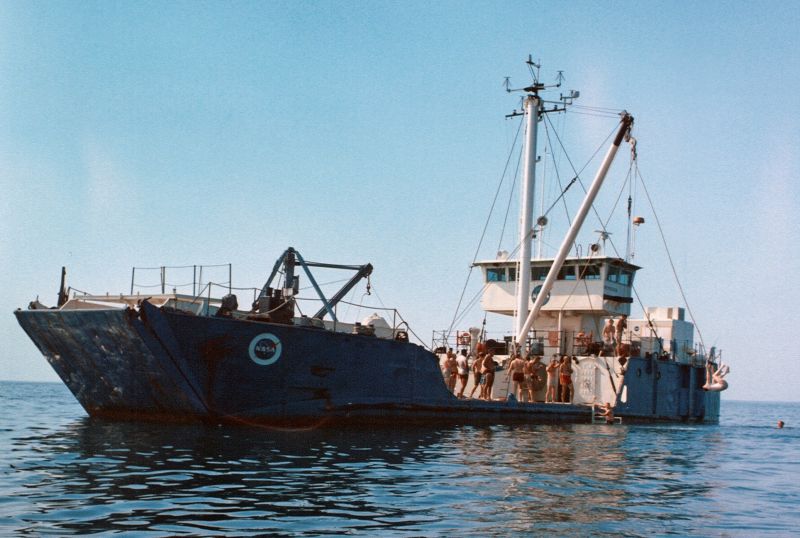
In 1964, NASA converted a Mark V into MV Retriever. Retriever was used to train astronauts for post-splashdown retrieval operations during the Gemini and Apollo programs. The ship had a new bridge, a hoist, and its sides were cut down at the midsection so people could jump into the water or climb aboard easily. MV Retriever used by NASA for water recovery training in 1966 (Photo: NASA) Another LCT, a Mark 2 converted into an LCT(R) was used after the war as a clandestine immigration ship, smuggling Jews into Mandatory Palestine. Another ship was still used as a dredge and construction vessel on Lake Superior as of 2007, and another one as a fishing and merchant vessel in Alaska as of 2016.
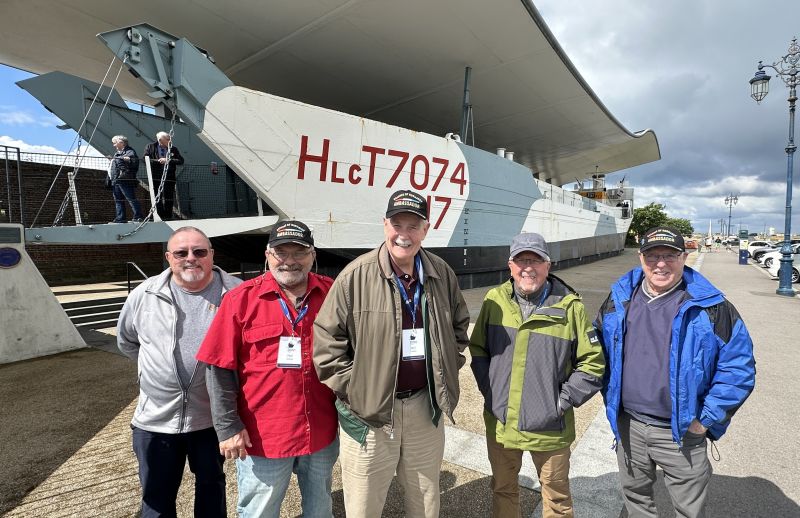
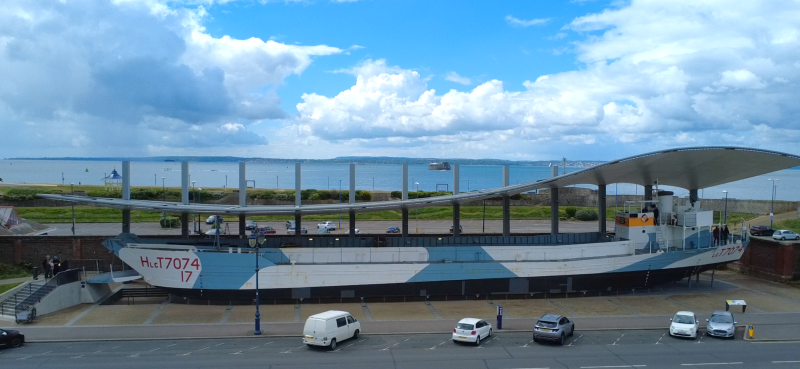
You can personally see an LCT on our Britain at War Tour. HM LCT 7074 is the last surviving LCT in the UK. She participated in the Normandy landings, and was used first as a club ship than a floating nightclub in the 60s and 70s. She eventually sank from neglect but was raised in 2014 and restored to display condition. She is on permanent display in Portsmouth, a location we visit on our British tours. Some of our passenger posing with the only surviving LCT in the United Kingdom on our tour (Photo: Author’s own)

.jpg)